
Preacher's Daughter
My experiences and connection with Ethel Cain & her music. Part 1 of the series.

This post will be part of a series. This is part 1, the rest is linked here!
About a year ago, I discovered the artist, Ethel Cain. I started off by listening to a few songs, and immediately added them to my daily playlists. That’s all I really kept it at for a while— listening to a select few because I liked the way they sounded. In September 2024, I saw a TikTok video about her song American Teenager. I realized I’d already had that song in my playlist for at least a year. That piqued my interest even more, leading me to listen to her entire discography.
When I tell you this was a life-changing moment for me, I mean it. I was shocked by the lyricism, the layers, and the literal chills some of the tracks gave me. It became a daily routine of mine— turn on my “Ethel Cain (All Songs)” playlist. Usually, it was accompanied by crying. I was going through one of the worst times in my life.
As I continued to get more into the whole story, who she is, and the entirety of her discography, I fell more in love. Preacher’s Daughter was my favorite album, genuinely ever. I loved all of the songs on there, but I hadn’t ever realized that there was a whole entire story behind it. I started to read different articles and analyses about the concepts and emotions about the album as a whole.
I was relating to it entirely differently that was intended. I think art is subjective, so I understood that, but I also wanted to understand the point of the album. Preacher’s Daughter is based on a fictional character— Ethel Cain— that paints a picture of intense emotions, graphic imagery, and so, so much more. Considering that, the meanings I have found between each lyric doesn’t necessarily align with the intention of them.

A bit about Ethel Cain
Hayden Anhedönia is the artist of Preacher’s Daughter. She uses Ethel Cain as pseudonym currently. She has used various aliases such as ΛTLΛS, White Silas, and Tommy. She grew up in Florida as the oldest of four in a Southern Baptist family. Throughout her life, she has talked a lot about sexuality and identity, first coming out as a gay at twelve, then as a bisexual trans woman later in her life. She has since left the church, and talked about her feelings towards religion. A user on Tumblr sent her a question— “do you still consider yourself a christian?” She responded with this:
“oh very much no. i still abide by the values i was raised on (love your neighbor, treat everyone with respect, by kind and gracious always) but i do not care abt religion lol. it’s embedded in my history and will always be a part of my art but mainly just cause i love horror and drama and what’s more horrifying and dramatic than devoting your life to god.”
Currently, Cain has an album set to be released on August 8th, 2025 titled Willoughby Tucker, I’ll Always Love You. It is meant to be a prequel to Preacher’s Daughter, and has two singles out right now. (Nettles and Fuck Me Eyes). Her music career started when she was eight, with classical piano lessons. Under those different names, she released a number of experimental tracks on Tumblr and Soundcloud. She has two EPs, Carpet Bed and Golden Age, along with a number of singles you can listen to here.
She has, very recently, received backlash over a number of (mostly) valid things, to which she responded with this statement. Old posts made in 2017 and 2018 resurfaced on Twitter, showing her using racial slurs, using fatphobic and xenophobic language, and making jokes about rape and incest. There were also accusations that she drew child pornography and is a zoophile— all of which she covered in her statement.
There is much more information to find online, through blogs, news stations, and her personal accounts, but in an effort to keep this short and sweet, I have only covered the basics.
The Original Story
The album, Preacher’s Daughter is based on this fictional character, Ethel Cain. Throughout each track, it covers topics of abuse, cannibalism, murder, violence, and sexual themes including prostitution and grooming. Consider this your trigger warning. I will add more specific ones over each part of this series, as well. The album’s main theme is finding a sense of self outside of the church, the struggles that are tied to that, and the horrific saga of Ethel Cain. She has talked a lot about the process of writing Preacher’s Daughter, and her experiences and timeline of it. Specifically on the themes of cannibalism, she has said
“So, when I was a kid I had this vivid imaginary scenario, like, when you’re a kid and you don’t know what sex is and you have these crushes on people that you can’t explain, there’s this need for physical intimacy that you can’t explain away with sex, so I would always imagine that I wanted to open myself up and pull someone into me and devour them. … I think cannibalism itself is crazy and it’s not anything new, but I think there’s a similarity between cannibalism and not being able to get someone that you love close enough to you so you have to literally devour them, and that’s still not close enough.”
There is a lot to unpack throughout this album that cannot be covered by just an overview of the album itself, so lets go through each song individually.
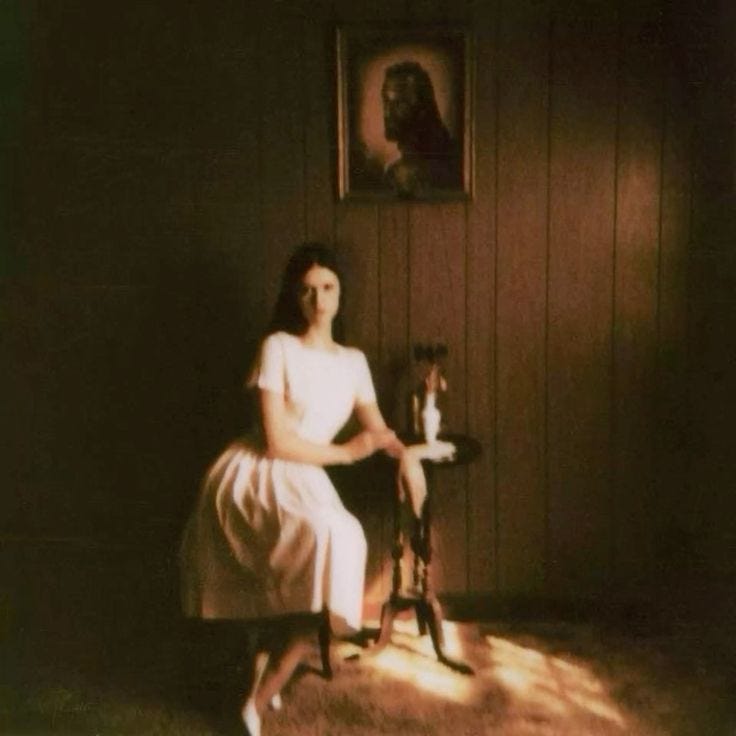
Family Tree (Intro)
Family Tree (Intro), is the first song on the album. It stars with a deep voice echoing through, presumably a church. This track is based on themes of Christianity and intergenerational trauma, including the inability to escape your blood, in the sense of family. Throughout the song, Cain is subjected to this trauma, setting the stage for the rest of the album.
American Teenager
American Teenager is set in Alabama, a small town meant to depict the intimacy of her familiar settings and relations. The song uses the previously mentioned themes of Christianity to show the deception American teenagers have, as in being promised something nonexistent. This marks the start of “healing,” from her religious trauma that comes with being the preacher’s daughter. It focuses on the glamorization of religion, alcohol, and other healthy coping mechanisms.
A House in Nebraska
This track, is based on a past lover of Cain— Willoughby Tucker. In this house in Nebraska, they planned a life together away from Alabama. While she reminisces in the memories they had shared together, she speaks of the role she played in their separation. She has talked about the inspiration behind this song—
“i don’t know if i’ve ever posted about this before but this is the actual house i wrote house in nebraska about. it’s called the wasden house, it’s by the highway just south of quitman, georgia. a man killed his sister and her husband in 1937 there because they threatened to commit him to an asylum. an old friend of mine used to live down the road, we would drive by it all the time right after high school and i’d daydream about it constantly. i hope it goes up for sale every day.”

Western Nights
The timing is now shifting towards the present, rather than the past. This is where the themes of violence and abuse start to appear. Here, we are introduced to another lover known as Logan Phelps. The lyrics in this song have lots of double meanings, many are risqué in nature. Her relationship with this boy is confusing, and seemingly built on a sense of his potential ability to save her rather than actual love.
Family Tree
This song shows themes of fleeing the scene— Ethel was an accomplice in Logan’s crimes, such as robbery. He was shot, freeing herself from him, also symbolizing her cutting ties with her “family tree.”
Hard Times
As we near the middle of the album, Cain goes on to explain the abuse and pent up feelings for her father. It shows the hypocrisy in religion, Christianity in this case, and the emotional rollercoaster she lived throughout her childhood.
Thoroughfare
Now, we are onto the third lover. Isaiah. They meet in Texas, and begin a journey towards California with the intention of finding their loves. It shows the intimacy between them, the time they spent together, and the fateful feeling of meeting each other.
Gibson Girl
This song involves themes of murder and cannibalism. Gibson Girl includes heavy themes of abuse, drugs, and prostitution. Their relationship takes a turn for the worse, Isaiah begins to act abusively towards Ethel. Throughout the song, he drugs her, and sells her into prostitution. He gaslights her into believing this is her meaning in life, what she wants to do. The earlier themes of cutting ties with her family come back into play with this “act of rebellion.”
Ptolemaea
Themes of religion reemerge in this song, hence the title. Ptolemaea is the ninth circle of hell, treachery. This song is according to Dante’s Inferno. In this ninth circle, he is in a frozen lake. People are trapped in the ice, each representing sinners punished for treachery of different sorts. There are four rings in the ice, each meant to show a different degree of treachery. In order of seriousness of the sin, they are listed as betrayal to family ties, guests, community, and lords. Considering the first part of the album, these are all so-called sins Ethel has committed. The lyrics show Ethel’s devotion to God, craving His blood. Meanwhile, Isaiah craves pleasure— depicted as his murder of Ethel and cannibalism of her body. The drugs she has been forced to take cause her to hallucinate, distorting the sounds and screams throughout the track.
August Underground
This is the first instrumental track of the album, a continuance of the hallucinations and distortion of Ptolemaea. As there are no lyrics in this song, it finalizes Ethel’s death.
Televangelism
Televangelism is another instrumental track, showing Ethel’s ascension to the afterlife. The vast difference in ambience from August Underground, is meant to symbolize the peace of death for Ethel.
Sun Bleached Flies
As we begin to close out the album, Ethel reflects on her life, past lovers, family, and childhood. This song brings back the religious themes, showing Ethel’s continuing crave for God. Lyrics in this song relate back to A House in Nebraska and American Teenager. This song has heavy influence from her longing for Willoughby Tucker, comfort of religion, and the past feelings covered in the beginning of the album.
Strangers
As the album’s final track, Strangers further reflects on her death, specifically in a message to Isaiah. The lyrics suggest her body is laid in a freezer to preserve it for Isaiah’s consumption of her. This song shows double meanings as well— her concern for Isaiah’s wellness after cannibalizing her, and her lack of a grave. There’s also continuance in the theme of being trapped or stuck, even in death. Her struggles with her family are touched on again, specifically with her mother.
Cain has also spoken about how she finished Preacher’s Daughter— by actually moved to Alabama and sleeping on an old iron-frame hospital bed in an old house without any neighbors. She said, “I forced myself to live this very pastoral, almost punishing lifestyle. It almost felt like method acting, but for music.” There is so much more to be dissected in each song, but in an effort to understand the album as a whole and each song individually, I wanted to provide a quick overview.
My experience with the album
This album— I hold it so close to my heart— is a very important piece of music to me. It is a beautiful emotional, haunting, gut-wrenching, harrowing, story. It allows interpretation in every aspect, the themes, lyrics, and stories specifically. To me, it is practically a manual for how my life has gone so far. It pains me to listen to the album, but it also provides me with comfort. I love the way it draws out emotions, whether they are surface level or have burrowed deep into my subconscious. I’ve written countless poetry pieces inspired by this album, so I thought it would be a great addition to my publication here.
Each part of this series will be about my personal experience and interpretation of each song. My hope is it will really allow me to fully understand the lyrics and how they resonate with me. Also, to put more of my thoughts out into the world. One of the things I love about music, and writing and other forms of art in general, is the meaning behind it. How subjective and personable it is. I know I’m using that word wrong, but I have my own definition of it stuck in my head and don’t care enough to find a synonym. Honestly, personable is one of the words I would use absolutely last to describe Preacher’s Daughter. So, please don’t mind my lack of thought in that description.
In this series, I want to cover each word, each layer of the music, each sound effect. I want to talk about exactly what it means to me. So please, bear with me throughout this process. I hope to post at least one part each day, so if you’re interested please follow along and leave a comment to let me know what you think!
so maybe i should finally check out ethel cain.................